

Committee against Torture Opens Eighty-Fourth Session in Geneva, Re-Elects Claude Heller as Chair of the Committee
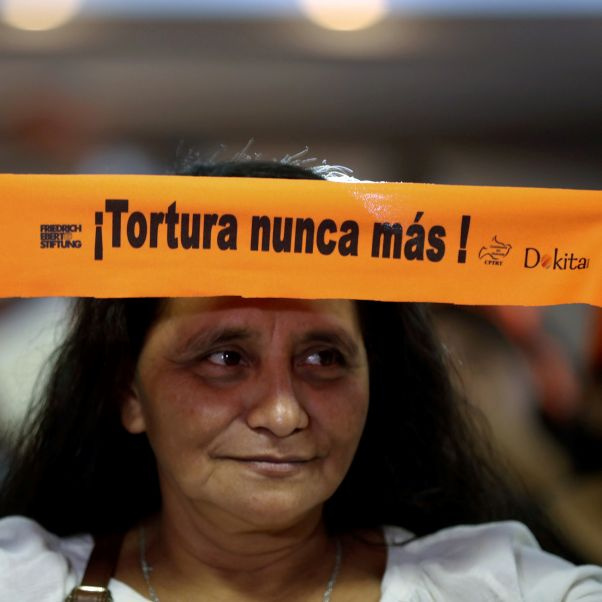
The Committee against Torture this morning opened its eighty-fourth session, which is being held in Geneva from 13 April to 1 May, during which it will review efforts by Gabon, Italy, Pakistan and Tajikistan to implement the provisions of the Convention against Torture and Other Cruel, Inhuman or Degrading Treatment or Punishment. During the meeting, two new Committee members made their solemn declarations, the Committee re-elected Claude Heller (Mexico) as its Chair and elected a new bureau, and it adopted its agenda for the session.
Mahamane Cisse-Gouro, Director of the Human Rights Council and Treaty Mechanisms Division, Office of the High Commissioner for Human Rights and Representative of the Secretary-General, opening the session, congratulated the two new members of the Committee, Lorena González Pinto of Guatemala and Moulaye Abdallahe Moulaye Abdallah of Mauritania and wished them every success in their duties.
Mr. Cisse-Gouro said the Committee played a vital role in the international human rights system, especially amid rising global crises and conflicts. Its work highlighted that torture and ill-treatment persisted, committed by both States and armed groups. Emphasis was placed on prevention, accountability, and ensuring victims had access to justice and reparations. Since November 2025, the number of States parties to the Convention had grown to 176, following the accession of St. Lucia this year, bringing it closer to universal ratification; 2026 also marked the sixtieth anniversary of two key international covenants, offering an opportunity to promote wider ratification and reinforce obligations, including the absolute prohibition of torture.
Recent developments related to the Committee’s work included a report by the Special Rapporteur presenting a Charter of Rights for victims of torture, aimed at strengthening justice and rehabilitation. The Commission on the Status of Women, which took place in March 2026, also addressed access to justice for women, and adopted an agreed conclusion which addressed the issue of the incarceration of women for the first time. Additionally, the United Nations General Assembly adopted a landmark resolution recognising the enslavement of Africans as a grave crime against humanity, underlining ongoing efforts toward accountability and reparative justice.
However, serious financial constraints were affecting the United Nations human rights system. Budget cuts had reduced treaty body activities, delayed country reviews and individual cases, and limited the work of mechanisms such as the Subcommittee on Prevention of Torture. In 2025, the Committee was unable to convene its full three-week July session, and lost an additional meeting week in November, leading to a postponement of six country reviews and the considerations of 30 individual communications. The United Nations Voluntary Fund for Victims of Torture had also faced drastic funding reductions, forcing cuts to essential support programmes.
Despite these challenges, efforts were ongoing to maintain operations in 2026, though uncertainty remained about future sessions, including the second session in 2026. The Office continued to urge Member States to increase funding, stressing that under-resourced mechanisms risked leaving serious human rights violations unaddressed. In closing, Mr. Cisse-Gouro expressed appreciation for the Committee’s work and conveyed best wishes for a productive session.
The newly elected Committee members Lorena González Pinto (Guatemala) and Moulaye Abdallah (Mauritania) then made their solemn declarations to the Committee.
The Committee then re-elected Claude Heller (Mexico) as Committee Chairperson.
Claude Heller, Committee Chairperson, thanked the Committee for entrusting him to be re-elected as Chair. The Committee had played an important role in an ever-increasing international situation, with the proliferation of conflict, impunity and ongoing violations of international humanitarian law, which had not made the Committee’s tasks easy. It was during these moments in history that the Committee needed to step up and reiterate the conviction of its mandate. Mr. Heller congratulated and welcomed the new Committee members. He said the Committee had agreed by consensus to elect three new Vice-Chairs: Ana Racu (Republic of Moldova), Huawen Liu (China), and Peter Vedel Kessing (Denmark). Abderrazak Rouwane (Morocco) had been elected as the Committee’s Rapporteur. Mr. Heller looked forward to these members input in their new roles.
During the session, Mr. Heller said, in addition to conducting in-person dialogues to review the reports of Gabon, Italy, Pakistan and Tajikistan, the Committee would also prepare and adopt lists of issues for Brazil, Colombia, Kazakhstan, Luxembourg, New Zealand, Romania, Slovakia, Spain and Switzerland. Further, it would consider 20 individual complaints, considering 16 cases on the merits and admissibility, and four cases for discontinuance. During the session, follow-up reports would be presented by the Committee’s rapporteurs for follow-up to individual complaints, concluding observations, and allegations of reprisals, and the Committee would also hold a meeting with the Subcommittee on the Prevention of Torture, for the presentation of its nineteenth report.
In closing, Mr. Heller thanked States, national human rights organizations, civil society organizations, particularly the World Organization against Torture, and the Secretariat for their support of the Committee.
During the meeting, the Committee adopted its provisional agenda for the session.
Documents relating to the Committee’s work, including reports submitted by States parties, will be available on the session’s webpage. Summaries of the public meetings of the Committee can be found here, and webcasts of the public meetings can be found here.
The Committee will next meet in public on Tuesday, 14 April at 10 a.m. to consider the fourth periodic report of Tajikistan (CAT/C/TJK/4).
___________
Produced by the United Nations Information Service in Geneva for use of the media;
not an official record. English and French versions of our releases are different as they are the product of two separate coverage teams that work independently.
CAT26.001E