

The Seventh Review Conference of the High Contracting Parties to the Convention on Certain Conventional Weapons (CCW) will take place from 16 to 20 November 2026 at the Palais des Nations in Geneva.
It will be presided by H.E. Mr. Julien Thöni, Permanent Representative of Switzerland to the Conference on Disarmament.
The Conference will be particularly significant for the future discussions on autonomous weapons systems following the work undertaken by the Group of Governmental Experts (GGE) on Emerging Technologies in the Area of Lethal Autonomous Weapons Systems (LAWS), which was held in Geneva in September 2026.
High contracting parties will evaluate recommendations and conclusions from the GCE final report adopted on 4 September 2026 (document CCW/GGE.1/2026/3).
The report recommends that the Review Conference consider and formulate a set of instrument elements and other possible measures to address emerging technologies in the area of lethal autonomous weapon system, and decide on future work modalities of the Group.
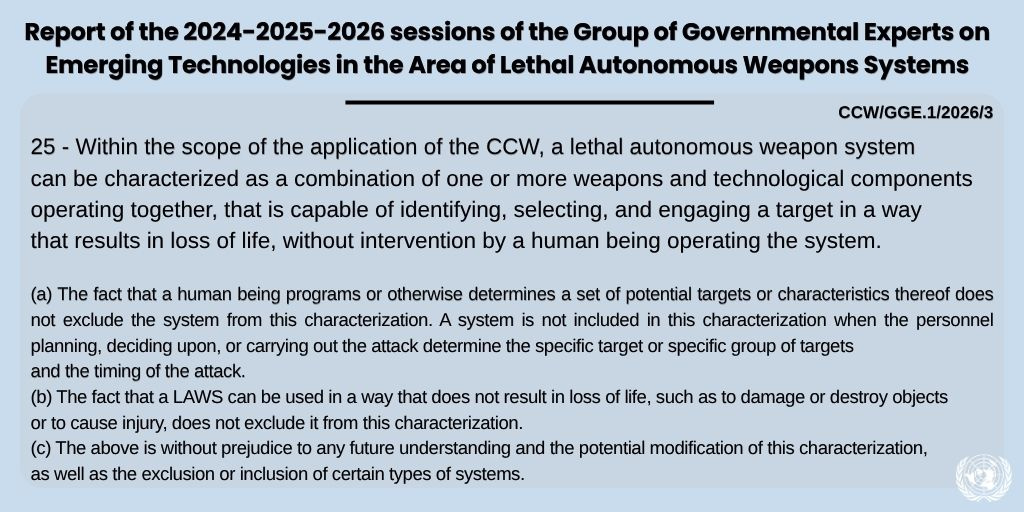
Paragraph 25 of the report provides the first-ever agreed consensus characterization of a lethal autonomous weapon system.
Convention on Certain Conventional Weapons
The Convention on Prohibitions or Restrictions on the Use of Certain Conventional Weapons Which May Be Deemed to Be Excessively Injurious or to Have Indiscriminate Effects as amended on 21 December 2001 (CCW) is usually referred to as the Convention on Certain Conventional Weapons. It is also known as the Inhumane Weapons Convention.
The purpose of the Convention is to ban or restrict the use of specific types of weapons that are considered to cause unnecessary or unjustifiable suffering to combatants or to affect civilians indiscriminately. The structure of the CCW – a chapeau Convention and annexed Protocols – was adopted in this manner to ensure future flexibility. The Convention itself contains only general provisions. All prohibitions or restrictions on the use of specific weapons or weapon systems are the object of the Protocols annexed to the Convention.
What are the key obligations of States Parties?
By ratifying the CCW, States commit to the:
- Prohibition of the use of any weapon of which the primary effect is to injure by fragments that are not detectable in the human body by X-rays;
- Prohibition and regulation of the use and transfer of non-detectable anti-personnel mines, booby traps, and other devices;
- Prohibition of, in all circumstances, making civilians the object of attack by incendiary weapons;
- Prohibition of the use of laser weapons specifically designed to cause permanent blindness and the transfer of such weapons to any State or non-State entity;
- Requirement of Parties to a conflict to take measures to reduce dangers posed by explosive remnants of war.
Autonomous weapons: Should Machines Decide?
Autonomous weapons: Should Machines Decide? How do we control AI weapons?
Featuring UN Under-Secretary-General Izumi Nakamitsu, Mary Wareham (Human Rights Watch), Nicole van Rooijen (Stop Killer Robots), and Thompson Chengeta (AI & Human Rights Expert), this video explainer explore the risks of lethal autonomous weapon systems — AI-powered machines that can select and kill targets without human oversight — and why the United Nations is calling for a global legally binding treaty.