

Human Rights Council Concludes Sixty-Second Regular Session after Adopting 28 Resolutions
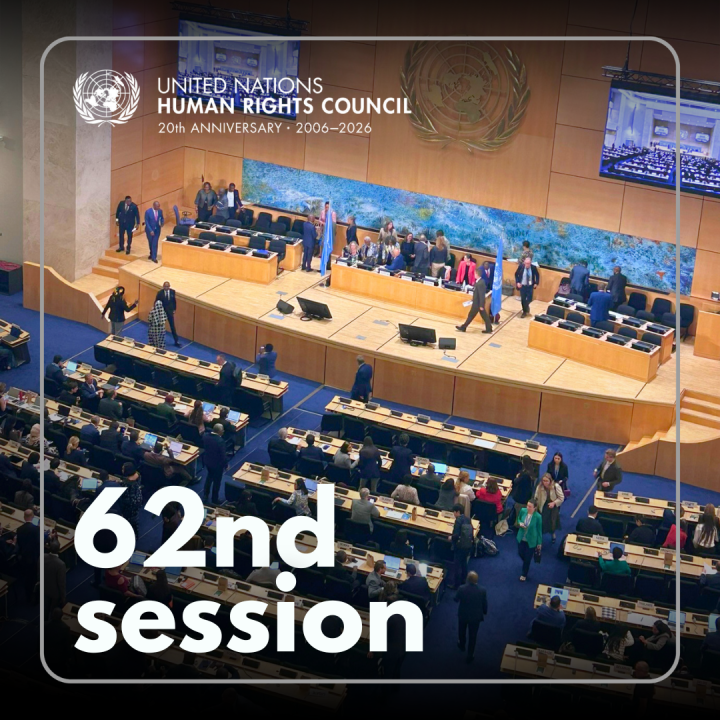
The Human Rights Council today concluded its sixty-second regular session after adopting 28 resolutions, in which, among other things, the Council voted to extend eight country-specific and thematic mandates.
Following an urgent debate, the Council adopted, without a vote, a resolution which strongly condemned the escalating violence committed by the Rapid Support Forces in and around El Obeid following 18 months of siege-like conditions, and expressed deep concern about the imminent risk of large-scale atrocities by them. The Council called on the independent international fact-finding mission for the Sudan to conduct an urgent inquiry into any violations and abuses of international human rights law, international humanitarian law and related international crimes, allegedly committed in and around El Obeid in the context of the ongoing conflict in the Sudan.
Several timely resolutions adopted during the session included those on the human rights implications of the obstruction and denial of humanitarian access and threats to the safety of humanitarian personnel in armed conflict; the
protection of health care in armed conflict; and human rights and neglected tropical diseases.
Another resolution called for a high-level panel discussion on “The twentieth anniversary of the Human Rights Council: building on its achievements and strengthening its effectiveness across the United Nations System”, to mark the Council’s twentieth anniversary.
The Council extended one country-specific mandate during the session. Under its second agenda item, it extended for one year the mandate of the Special Rapporteur on the situation of human rights in Eritrea.
In addition, the Council decided to extend, for a period of three years, seven thematic mandates: those of the Working Group on the issue of human rights and transnational corporations and other business enterprises; the Special Rapporteur on the rights of persons with disabilities; the Special Rapporteur on the right to education; the Special Rapporteur on extrajudicial, summary or arbitrary executions; the Special Rapporteur on the independence of judges and lawyers; the Independent Expert on human rights and international solidarity; and the Special Rapporteur on extreme poverty and human rights.
Further resolutions adopted concerned the situation of human rights of Rohingya Muslims and other minorities in Myanmar; the enhancement of international cooperation in the field of human rights; the role of States in countering the negative impact of disinformation on the enjoyment and realisation of human rights; freedom of opinion and expression; the elimination of all forms of discrimination against women and girls; human rights and climate change; the elimination of discrimination against persons affected by leprosy/Hansen’s disease and their family members; human rights and the civilian acquisition, possession and use of firearms; promoting, protecting and respecting women’s and girls’ full enjoyment of human rights in humanitarian situations; child, early and forced marriage; the Social Forum; strengthening the voluntary funds for the Universal Periodic Review mechanism of the Human Rights Council; technical assistance and capacity-building for the Member States of the Community of Portuguese-speaking Countries; technical assistance and capacity-building for empowering women’s access to education and work in digital and cybersecurity-related fields; and technical assistance and capacity-building for South Sudan.
Also during the session, the Council adopted the outcomes of the Universal Periodic Reviews of 15 countries, namely Kyrgyzstan, Kiribati, Guinea, Lao People's Democratic Republic, Spain, Lesotho, Kenya, Armenia, Guinea-Bissau, Sweden, Grenada, Türkiye, Guyana, Kuwait and Nicaragua.
On the final day of its sixty-second session, the Council appointed four mandate holders and adopted, ad referendum, the draft report of the session.
Marcos Gómez Martínez, Vice-President and Rapporteur of the Human Rights Council, presenting the session report, said in addition to adopting 28 resolutions, the Council had held 29 interactive dialogues, three enhanced interactive dialogues, five panel discussions, and one urgent debate, and adopted the Universal Periodic Review outcomes of 15 countries.
In his concluding remarks, Sidharto Reza Suryodipuro, President of the Human Rights Council, expressed profound gratitude to all those who had made the session possible, including the members of the Council’s Bureau and Secretariat, conference services, other United Nations staff, Member States and civil society.
All information concerning resolutions, including full resolutions and the voting results can be found on the Human Rights Council extranet.
The sixty-second regular session of the Council was held from 15 June to 8 July. The sixty-third regular session of the Council is scheduled to be held from 7 September to 9 October 2026.
Action on Resolutions
Action on Resolution Under Agenda Item One on Organizational and Procedural Matters
In a resolution (A/HRC/62/L.48) on the Human rights situation in and around El Obeid, in the context of the ongoing conflict in the Sudan, adopted without a vote, the Council strongly condemns the escalating violence committed by the Rapid Support Forces and their associated and allied forces in and around El Obeid following 18 months of siege-like conditions … and expresses deep concern about the imminent risk of large-scale atrocities by the Rapid Support Forces, including conflict-related sexual violence faced by hundreds of thousands of civilians, including children, and internally displaced persons in and around El Obeid; requests the Office of the United Nations High Commissioner for Human Rights to present an oral update to the Human Rights Council on the human rights situation in and around El Obeid in the context of the ongoing conflict in the Sudan before the end of its sixty-third session; and requests the independent international fact-finding mission for the Sudan to conduct, within its existing resources, an urgent inquiry into any violations and abuses of international human rights law and violations of international humanitarian law and related international crimes, allegedly committed in and around El Obeid in the context of the ongoing conflict in the Sudan, and encourages the fact-finding mission to update the Human Rights Council on this inquiry during the interactive dialogue at its sixty-third session and to update the General Assembly during the interactive dialogue at its eighty-first session.
Action on Resolutions Under Agenda Item Two on the Annual Report of the United Nations High Commissioner for Human Rights and Reports of the Office of the High Commissioner and the Secretary-General
In a resolution (A/HRC/62/L.3/Rev.1) on the Situation of human rights in Eritrea, adopted by a vote of 23 in favour, 6 against and 17 abstentions, the Council decides to extend the mandate of the Special Rapporteur on the situation of human rights in Eritrea for a further period of one year; requests the Special Rapporteur to submit and present a report on the situation of human rights in Eritrea to the Council at its sixty-fifth session, to be followed by an enhanced interactive dialogue with the participation of the Special Rapporteur, the Office of the High Commissioner for Human Rights and other relevant stakeholders, and to the General Assembly at its eighty-first session; continues to call upon the Government of Eritrea to cooperate fully with the Office of the High Commissioner, relevant treaty bodies and the Council and its mechanisms, including the Special Rapporteur; and requests the Secretary-General to provide the Special Rapporteur with all the information and resources necessary to fulfil the mandate.
In a resolution (A/HRC/62/L.20) on the situation of human rights of Rohingya Muslims and other minorities in Myanmar, adopted without a vote, the Council recalls its resolution 53/26, in which the Council requested the High Commissioner for Human Rights to present a report at its fifty-ninth session, and requests the High Commissioner to present that report at its sixty-third session, to be followed by an enhanced interactive dialogue with the Independent Investigative Mechanism for Myanmar; also recalls resolution 59/2, in which the Council requested the High Commissioner to present an oral update to the Council at its sixty-fourth session, to be followed by an interactive dialogue, and a report at its sixty-sixth session, to be followed by an enhanced interactive dialogue with the Independent Investigative Mechanism for Myanmar, and requests the High Commissioner to present that report at its sixty-fifth session, to be followed by an interactive dialogue, and the said oral update at its sixty-sixth session, to be followed by an enhanced interactive dialogue with the Independent Investigative Mechanism for Myanmar; and requests the High Commissioner to monitor and follow up on the implementation of the recommendations made by the independent international fact-finding mission on Myanmar and to continue to track progress in the situation of human rights in Myanmar, and to present a report to the Council at its sixty-eighth session, to be followed by an interactive dialogue, and an oral update to the Council at its sixty-ninth session, to be followed by an enhanced interactive dialogue with the Independent Investigative Mechanism for Myanmar, and a report to the General Assembly at its eighty-second session.
In a resolution (A/HRC/62/L.25/Rev.1) on the Human rights implications of the obstruction and denial of humanitarian access and threats to the safety of humanitarian personnel in armed conflict, adopted without a vote (as orally revised), the Council requests the High Commissioner for Human Rights to prepare a comprehensive report on the human rights impact of attacks, acts of violence and threats against humanitarian personnel, including national and locally recruited personnel, and the obstruction and unlawful denial of humanitarian access, in consultation with relevant United Nations entities, to be presented to the Council at its sixty-seventh session.
Action on Resolutions Under Agenda Item Three on the Promotion and Protection of All Human Rights, Civil, Political, Economic, Social and Cultural Rights, including the Right to Development
In a resolution (A/HRC/62/L.1) on Business and human rights, adopted without a vote, the Council requests the High Commissioner for Human Rights to convene a yearly consultation, involving representatives of States and other stakeholders, regarding challenges, good practices and the implementation of the Guiding Principles on Business and Human Rights, and to submit a report thereon to the Council at its seventy-first session; decides that the Working Group on the issue of human rights and transnational corporations and other business enterprises shall continue to guide the work of the Forum on Business and Human Rights and to prepare its annual meetings, and invites the Working Group to chair the Forum and to submit a report on the proceedings and thematic recommendations of the Forum to the Council for its consideration; and also decides to extend the mandate of the Working Group on the issue of human rights and transnational corporations and other business enterprises for a period of three years.
In a resolution (A/HRC/62/L.2) on Enhancement of international cooperation in the field of human rights, adopted by a vote of 29 in favour, 16 against and 1 abstention, the Council requests all States and the United Nations system to explore and foster complementarities among North-South, South-South and triangular cooperation aiming at the enhancement of international cooperation in the field of human rights, and requests the High Commissioner for Human Rights to undertake concrete activities in this regard, including by studying, promoting and preparing a compilation of best practices; requests the High Commissioner to prepare a new report on the work of the Office of the High Commissioner in the implementation and enhancement of international cooperation in the field of human rights, proposing also possible ways to face the challenges to the promotion and protection of human rights, including the right to development, and to submit the report to the Council at its sixty-fifth session; and decides to continue its consideration of the matter at its sixty-fifth session, in accordance with its annual programme of work.
In a resolution (A/HRC/62/L.4) on the Special Rapporteur on the rights of persons with disabilities, adopted without a vote, the Council decides to extend the mandate of the Special Rapporteur on the rights of persons with disabilities for a further period of three years, to enable the mandate holder to continue to work in accordance with the mandate established by the Human Rights Council in its resolution 53/14; and requests the Special Rapporteur to present an annual report to the Human Rights Council and to present a report to the General Assembly at its eighty-first and eighty-third sessions, in accessible formats, including Braille and easy-to-read reports and International Sign interpretation and closed captioning, during the presentation of the reports, and in accordance with their respective programmes of work.
In a resolution (A/HRC/62/L.6) on the Right to education, adopted without a vote (as orally revised), the Council decides to extend the mandate of the Special Rapporteur on the right to education for a further period of three years; requests the Secretary-General and the High Commissioner for Human Rights to continue to provide the Special Rapporteur with all the human and financial resources necessary for the effective fulfilment of the mandate; and requests the Special Rapporteur to continue to submit an annual report to the Council and to the General Assembly covering all activities relating to the mandate with a view to maximising the benefits of the reporting process.
In a resolution (A/HRC/62/L.9) on the Role of States in countering the negative impact of disinformation on the enjoyment and realization of human rights, adopted without a vote, the Council requests the Office of the High Commissioner, in consultation with relevant United Nations entities, the Special Rapporteur on the promotion and protection of the right to freedom of opinion and expression, technical experts, members of civil society and other stakeholders, to prepare a comprehensive study on the human rights implications of the use of artificial intelligence in the dissemination of disinformation, including challenges related to synthetic media, automated systems and coordinated digital campaigns, including in the context of foreign information manipulation and interference, as well as safeguards and human rights-based approaches aimed at enhancing transparency and information integrity, and to present the study to the Human Rights Council at its sixty-seventh session.
In a resolution (A/HRC/62/L.11) on the Mandate of the Special Rapporteur on extrajudicial, summary or arbitrary executions, adopted without a vote, the Council requests the Special Rapporteur on extrajudicial, summary or arbitrary executions to continue to examine situations of extrajudicial, summary or arbitrary executions in all circumstances and for whatever reason, and to submit the findings to the Council on an annual basis and to the General Assembly at its eighty-first and eighty-second sessions; requests the Secretary-General to provide the Special Rapporteur with an adequate and stable level of the human, financial and material resources necessary to carry out the mandate effectively, including through country visits; and decides to extend the mandate of the Special Rapporteur on extrajudicial, summary or arbitrary executions for three years.
In a resolution (A/HRC/62/L.12/Rev.1) on Freedom of opinion and expression, adopted without a vote, the Council requests the Office of the High Commissioner for Human Rights, in consultation with all relevant stakeholders, and, drawing on international human rights law and relevant human rights standards, to prepare a comprehensive study on emerging and transnational threats to the right to freedom of opinion and expression, including challenges arising from the misuse of new and emerging digital technologies, including artificial intelligence, as well as from the impact of legislative measures adopted in response to these threats, and to present the study to the Council at its sixty-seventh session.
In a resolution (A/HRC/62/L.15) on the Independence and impartiality of the judiciary, jurors and assessors, and the independence of lawyers: mandate of Special Rapporteur on the independence of judges and lawyers, adopted without a vote, the Council decides to extend the mandate of the Special Rapporteur on the independence of judges and lawyers for a period of three years on the same terms as provided by the Human Rights Council in its resolution 53/12 of 13 July 2023.
In a resolution (A/HRC/62/L.16/Rev.1) on the Elimination of all forms of discrimination against women and girls, adopted without a vote, the Council decides to continue its consideration of the issue of the elimination of all forms of discrimination against women and girls as a matter of high priority, in conformity with its programme of work, at its sixty-eighth session, and to remain seized of the matter of addressing care and support from a human rights perspective with relevant stakeholders.
Amendments L.38, L.39, L.45, L.46 and L.47 were voted on and rejected.
In a resolution (A/HRC/62/L.18/Rev.1) on Human rights and climate change, adopted without a vote, the Council recalls Council resolution 47/24 of 14 July 2021, in which the Council decided to incorporate into its annual programme of work, beginning in 2023, at a minimum a panel discussion, decides that the annual panel discussion to be held at the sixty-fifth session shall be focused on “Human rights and climate adaptation: challenges, good practices, and recommendations on actionable pathways to safeguard the enjoyment of human rights of the present generation and the needs and interests of future generations”, and also decides that the panel discussion will have International Sign interpretation and captioning; requests the High Commissioner for Human Rights to submit a summary report on the panel discussion held at the sixty-fifth session to the Council at its sixty- seventh session, and to make the report available in accessible formats, including in easy-to-read versions; and requests the Secretary-General, in consultation with all relevant stakeholders, to prepare an analytical study on “Human rights and climate adaptation: challenges, good practices, and recommendations on actionable pathways to safeguard the enjoyment of human rights of the present generation and the needs and interests of future generations”, and to submit the report to the Council at its sixty-sixth session, to be followed by an interactive dialogue, and for it to be made available in accessible formats, including in easy-to-read versions.
In a resolution (A/HRC/62/L.5) on the Elimination of discrimination against persons affected by leprosy/Hansen’s disease and their family members, adopted without a vote, the Council requests the High Commissioner for Human Rights to submit a comprehensive report to the Council at its seventy-first session on the implementation of the principles and guidelines for the elimination of discrimination against persons affected by leprosy and their family members, as well as on progress towards the elimination of discrimination and protection and fulfilment of the human rights of persons affected by leprosy/Hansen’s disease, to be followed by an interactive dialogue; welcomes the efforts of States and relevant stakeholders to hold annual high-level awareness-raising events with persons affected by leprosy/Hansen’s disease at the centre and towards the protection and fulfilment of their human rights; and requests the High Commissioner to include the information on the efforts undertaken by States and relevant stakeholders in the report to be submitted to the Council, and to transmit it to the General Assembly.
In a resolution (A/HRC/62/L.8) on the Mandate of the Independent Expert on human rights and international solidarity, adopted by a vote of 29 in favour, 16 against and 1 abstention, the Council decides to extend the mandate of the Independent Expert on human rights and international solidarity for a period of three years; requests the Independent Expert to continue holding informal consultations between September 2026 and April 2027 on the revised draft declaration on the right to international solidarity, with a view to submitting the revised draft declaration to the Council for consideration on its sixty-fifth session; requests the Secretary-General and the High Commissioner for Human Rights to provide the Independent Expert with all the human and financial resources necessary for the effective fulfilment of the mandate; and requests the Independent Expert to report regularly to the Council and to the General Assembly in accordance with their respective programmes of work.
In a resolution (A/HRC/62/L.13) on Human rights and the civilian acquisition, possession and use of firearms, adopted without a vote, the Council expresses its concern that the global number of firearms is rising, that civilians possess far more firearms worldwide than the military and law enforcement sectors combined, and that the majority of these firearms are unregistered and illicit; and requests the High Commissioner to prepare, in consultation with Member States, a study on the human rights impact of the diversion, possession, acquisition, illicit trafficking and use of firearms and ammunition by national and transnational organized criminal groups and other criminal actors, and to present the study to the Human Rights Council at its sixty-seventh session.
In a resolution (A/HRC/62/L.21/Rev.1) on Promoting, protecting and respecting women’s and girls’ full enjoyment of human rights in humanitarian situations, adopted without a vote, the Council requests the United Nations High Commissioner for Human Rights to submit to the Human Rights Council, at its seventy-first session, an analytical report on the impact of the funding gaps and of the humanitarian development divide on the enjoyment of human rights by all women and girls in humanitarian situations and recommendations for bridging the gap and fulfilling the rights of women and girls in a manner consistent with international human rights law, with input from all relevant stakeholders, including States Members of the United Nations, United Nations bodies, agencies, funds and programmes, the treaty bodies, the special procedures of the Council, national human rights institutions, civil society organizations and women and girls in humanitarian situations.
In a resolution (A/HRC/62/L.24/Rev.1) on Child, early and forced marriage, adopted without a vote (as orally revised), the Council encourages States to implement comprehensive, human rights-based, gender-responsive and multisectoral measures to prevent and eliminate child, early and forced marriage by taking into account the guidelines of the Office of the High Commissioner for Human Rights and its operational recommendations; and requests the Office of the High Commissioner for Human Rights, in collaboration with relevant entities of the United Nations system, within their respective mandates, to support governments, civil society and other relevant stakeholders in the implementation of the guidelines, to prevent and redress child, early and forced marriage, through technical cooperation workshops by the sixty-eighth session of the Council.
Amendments L.41, L.42, L.43, and L.44 were voted on and rejected.
In a resolution (A/HRC/62/L.26/Rev.1) on the Protection of health care in armed conflict, adopted without a vote (as orally revised), the Council decides to convene, at its sixty-sixth session, an expert-level panel discussion with the participation of States, relevant United Nations agencies, funds and programmes, academics, health experts, non-governmental organizations and national human rights institutions, with the objective of exchanging experiences and good practices, identifying challenges and opportunities, enhancing understanding of the protection of healthcare during armed conflict, including situations of occupation, and outlining and clarifying relevant obligations under international human rights law and international humanitarian law; and requests the Office of the High Commissioner for Human Rights to prepare an analytical summary report on the panel discussion and to submit it to the Council at its sixty-seventh session.
In a resolution (A/HRC/62/L.27) on Human rights and neglected tropical diseases, adopted without a vote (as orally revised), the Council requests the Office of the High Commissioner for Human Rights to prepare a comprehensive report on the human rights dimensions of neglected tropical diseases, to be made available in accessible formats, in consultation with States, relevant United Nations entities, and other relevant stakeholders, and to submit the report to the Council at its sixty-fifth session, and requests that the Office, in that study, provide an overview of measures that States can adopt to ensure that persons affected by neglected tropical diseases are not subjected to poverty, gender inequality, and discrimination; examine how the Council and its relevant mechanisms may contribute, within their existing mandates, to addressing the human rights dimensions of neglected tropical diseases; and recommend concrete steps that could be taken across the United Nations system to better support States in strengthening the integration of human rights considerations into their national, regional and global responses to neglected tropical diseases.
In a resolution (A/HRC/62/L.19/Rev.1) on the Twentieth anniversary of the Human Rights Council, adopted without a vote (as orally revised), the Council decides to convene, during the high-level segment of the Human Rights Council at its sixty-fourth session, a high-level panel discussion on “The twentieth anniversary of the Human Rights Council: building on its achievements and strengthening its effectiveness across the United Nations System”, and invites the President of the Human Rights Council to consider this theme for the annual high-level panel discussion on human rights mainstreaming, to be held at the sixty-fourth session of the Council; and requests the Office of the United Nations High Commissioner for Human Rights to prepare a summary report of the above-mentioned high-level panel discussion, to be submitted to the sixty-sixth session of the Human Rights Council.
In a resolution (A/HRC/62/L.22) on Extreme poverty and human rights, adopted without a vote (as orally revised), the Council decides to extend, for a period of three years, the mandate of the Special Rapporteur on extreme poverty and human rights, as set out in Human Rights Council resolution 8/11; and requests the Special Rapporteur to submit an annual report on the implementation of the present resolution to the Human Rights Council, and, on a biennial basis, to the General Assembly, as of its eighty-first session, and, in accordance with their programmes of work.
Action on Resolution Under Agenda Item Five on Human Rights Bodies and Mechanisms
In a resolution (A/HRC/62/L.7) on the Social Forum, adopted without a vote, the Council decides that the Social Forum will meet for two working days in 2027, in Geneva, and also decides that the 2027 Social Forum should be focused on the achievements, challenges and good practices in the field of social protection for the realisation of human rights: the role of international cooperation and solidarity; requests the President of the Council to appoint, as early as possible, from candidates nominated by regional groups, the Chair-Rapporteur for the 2027 Social Forum, bearing in mind the principle of regional rotation; requests the High Commissioner for Human Rights to facilitate the participation in the 2027 Social Forum of no fewer than 10 experts, including, as appropriate, representatives of the academic, scientific, health and technological sectors and civil society and grass-roots organizations in developing countries, and representatives of relevant international organizations; and requests the 2027 Social Forum to submit a report containing its conclusions and recommendations to the Council at its sixty-eighth session.
Action on Resolution Under Agenda Item Six on the Universal Periodic Review
In a resolution (A/HRC/62/L.10) on Strengthening the voluntary funds for the Universal Periodic Review mechanism of the Human Rights Council, adopted without a vote, the Council requests the Secretary-General to continue to provide the regular budget-funded dedicated capacity of the Office of the High Commissioner for Human Rights to implement the mandates of the two voluntary funds, including the dedicated capacity in the regional offices and hubs of the Office of the High Commissioner, during the fourth and fifth cycles of the Universal Periodic Review.
Action on Resolutions Under Agenda Item 10 on Technical Assistance and Capacity-Building
In a resolution (A/HRC/62/L.14) on Technical assistance and capacity-building for the Member States of the Community of Portuguese-speaking Countries, adopted without a vote, the Council requests the United Nations High Commissioner for Human Rights to present an oral update to the Human Rights Council at its sixty-sixth session on the outcomes and opportunities of the technical assistance and capacity-building activities for States members of the Community of Portuguese-speaking Countries, including the opportunities under the 2006 memorandum of understanding between the Office of the High Commissioner and the Community and on the cooperation of the Office of the High Commissioner with the Community’s network of human rights focal points.
In a resolution (A/HRC/62/L.17) on Technical assistance and capacity-building for empowering women’s access to education and work in digital and cybersecurity-related fields, adopted without a vote, the Council decides to convene, under item 10 of its agenda at its sixty-sixth session, a panel discussion on the role of technical assistance and capacity-building in empowering women in the digital and cybersecurity-related fields through the realisation of the rights to education and work and the fulfilment of their human rights and in eliminating structural barriers preventing women’s full, equal and meaningful participation in those fields; and requests the High Commissioner for Human Rights to prepare a summary report on the panel discussion and to submit it to the Council at its sixty-eighth session.
In a resolution (A/HRC/62/L.23) on Technical assistance and capacity-building for South Sudan, adopted without a vote, the Council requests the Office of the United Nations High Commissioner for Human Rights, in cooperation and collaboration with the Government of South Sudan and relevant mechanisms of the African Union, to enhance the technical assistance provided to the Government of South Sudan to continue to assist it in addressing human rights challenges in the post-conflict transition; also requests the Office of the High Commissioner to present a comprehensive report to the Council at its sixty-sixth session, to be followed by an interactive dialogue, with the participation of representatives of the African Union; and further requests the Office of the High Commissioner to submit the above-mentioned report and recommendations to the Human Rights Council, then to share them with the African Union and all relevant organs of the United Nations, including the United Nations Mission in South Sudan.
Other Matters
The Council appointed four mandate holders: the Special Rapporteur on the promotion and protection of the right to freedom of opinion and expression, Leopoldo Maldonado Gutierrez (Mexico); the Special Rapporteur on the implications for human rights of the environmentally sound management and disposal of hazardous substances and wastes, Bethanie Carney Almroth (Sweden); the Special Rapporteur on the right of everyone to the enjoyment of the highest attainable standard of physical and mental health, Mariangela Simao (Brazil); and the Special Rapporteur on torture and other cruel, inhuman or degrading treatment or punishment, Pau Perez Sales (Spain).
In addition, the Council adopted its draft report ad referendum for the sixty-second session.
___________
Produced by the United Nations Information Service in Geneva for use of the media;
not an official record. English and French versions of our releases are different as they are the product of two separate coverage teams that work independently.
HRC26.007E