

Celebrating the 20-Year Legacy of the International Convention for the Protection of All Persons from Enforced Disappearance

On 20 December 2026, the International Convention for the Protection of All Persons from Enforced Disappearance turns 20. Before the celebrations begin, here’s a refresher on enforced disappearances, the legacy of the Convention and the Committee that oversees its implementation.
What is enforced disappearance?

“Enforced disappearance”, following the definition of the Convention, is a form of repression by a State. It involves the deprivation of liberty by agents of the State or by persons acting with its authorisation, followed by the “denial of recognition of the deprivation of liberty or concealment of the fate or whereabouts of the disappeared person”[1].
In concrete terms, it involves State agents forcibly taking persons, without explanation, to an unknown location. In enforced disappearances, victims are often subjected to torture, sexual violence, other violations of their rights or even death. When relatives ask the authorities where the person is, they either fail to respond or provide information that does not reveal the victim’s location[2]. Sometimes, authorities open investigations into enforced disappearances, but due to the direct involvement of the State in the crime or the lack of available evidence, these are rarely successful.
Removed from the protection of the law, disappeared persons are deprived of all the rights normally accorded to arrested persons, including the right to contact their families, friends and representatives, and the right to challenge their arrest and receive a fair trial. For the families and loved ones of the victims, the uncertainty resulting from enforced disappearance is a source of unspeakable and permanent anguish — days turn into months, into years, with no news of what happened or where their loved one is.
How the Convention helps prevent enforced disappearances, locate disappeared persons, and combat impunity
As one researcher explains[3], “enforced disappearance is not just another human rights violation. It is not just a kidnapping, an act of torture, arbitrary detention or an extrajudicial execution. It is all this and more: it is a specific, global act, which must be understood as such by the law.” In this context, the Convention is the only universal treaty specifically dedicated to the prevention and eradication of this heinous crime, with the rights of victims to know the truth and obtain justice and reparation at its core.
The Convention is the only universal treaty specifically dedicated to preventing and eradicating enforced disappearances, placing victims’ rights to truth, justice and reparation at its core. |
The Convention begins by stating that no circumstances can justify enforced disappearance. It then defines this crime based on the reality of the cases and pre-existing legal texts, while seeking to prevent enforced disappearances, locate and release disappeared persons, and combat impunity.
States that ratify the Convention (known as “States parties” to the Convention) undertake to not expel or return a person to a country where he or she is at risk of enforced disappearance. The Convention calls on States parties to create registers that make it possible to know the whereabouts of all persons deprived of their liberty. States parties must also strengthen the guarantees enjoyed by every person in detention, including the right to consult a lawyer and a doctor. These professionals ensure that the person is indeed detained, that they know their rights and that they are not being ill-treated.
To prevent impunity, the Convention obliges State authorities to include enforced disappearance in their penal codes as a stand-alone crime, with penalties strong enough to be a deterrent. Authorities must also ensure that the “statute of limitations” (a law that sets the maximum time for initiating legal proceedings) is sufficiently long and only begins from the moment the enforced disappearance has “ended”, that is, when the person concerned has been found. This provision is essential to prevent the relatives of a disappeared person from being prevented from accessing justice, even when they do not have information about the fate of their loved one. Finally, the Convention calls on authorities to prosecute not only those directly responsible for an enforced disappearance, but also those who ordered or encouraged the commission of the crime.
Importantly, the Convention broadens the concept of “victim” to include the circle of relatives of the disappeared person. According to the Convention, any person who suffers direct harm as a result of an enforced disappearance is considered a victim and a holder of rights, including the right to know the truth about the disappearance and the fate of the disappeared person, the right to justice, and the right to receive compensation.
A brief history of the Convention
The idea of adopting a universal standard to specifically combat the crime of enforced disappearance appeared in the late 1970s and early 1980s. At that time, dictatorial regimes in Latin America and other regions carried out enforced disappearances to silence their opponents and intimidate other dissenters.
Like other international human rights treaties, the drafting and subsequent adoption of the Convention was the result of efforts led by civil society – in particular, in this case, by families of missing persons on several continents – with assistance from legal experts and States.
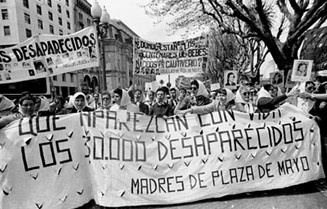
In Argentina in the 1970s and 1980s, the non-violent protests of the Mothers of Plaza de Mayo, whose children had been victims of enforced disappearance, sparked a movement that went far beyond their country. Their approach was relayed by, among others, Argentine intellectuals at an international conference organised by the French Senate in 1981.
Within the United Nations, an initiative in 1979 by France led to the creation in 1980 of the Working Group on Enforced Disappearances, the first UN investigative mechanism on this issue. In 1992, the UN General Assembly adopted the Declaration on the Protection of All Persons from Enforced Disappearance, before French human rights expert Louis Joinet drafted the text of a convention against enforced disappearances in 1998 that would have the force of law.
This text was negotiated by UN Member States, according to a process already followed for other international treaties, until the adoption of the final text of the Convention by the Human Rights Council and then by the UN General Assembly in 2006. It is the twentieth anniversary of this adoption that we are celebrating in 2026. However, the Convention did not formally enter into force until 2010, after twenty UN Member States ratified it[4].
The Committee on Enforced Disappearances, the Convention’s keeper
With the new treaty in force, the next important step was overseeing its implementation. To this end, the Convention provides, in its article 26, for the creation of a group of independent experts whose mission is to monitor the way in which States parties apply it in practice. This is the Committee on Enforced Disappearances, which began its work in 2011 and which, from 9 to 19 March 2026, meets for its thirtieth session.
The Committee has 10 expert members, appointed by the States parties, who are responsible for reviewing the measures taken by those States to prevent and put an end to enforced disappearances, in accordance with the rights and obligations specified in the Convention. This monitoring is carried out mainly through reports prepared by States parties and submitted to the Committee. The Committee analyses the reports and discusses them in constructive dialogues with State delegations. Following these dialogues, the Committee makes recommendations and provides advice on how to implement the Convention more effectively.
Another mechanism available to the Committee is the so-called “urgent action” procedure, which allows it to request States to take immediate measures to search for and locate a disappeared person, and to investigate their disappearance. The Committee carries out this work daily, registering cases and following up on the measures taken by States to search for missing persons. As of 3 March 2026, the Committee had registered 2,239 urgent actions and closed 546 of these cases as the missing person had been located. Some 427 persons have been found alive since the activation of this procedure in 2012.
The Committee can also receive complaints of rights violations by States parties from or on behalf of individuals and assess whether a violation has taken place[5]. To date, the Committee has considered four individual complaints.
Finally, if it receives information that a State party is seriously violating the provisions of the Convention, the Committee may visit the country concerned to gather specific information. Following these visits, it transmits detailed recommendations to the authorities concerned on what they should do to remedy the problems it has identified. To date, the Committee has conducted visits to Mexico (2021), Iraq (2022) and Colombia (2024).
The invisible presence of the disappeared
Present at the conference on elaborating an international treaty on enforced disappearances organised by the French Senate in 1981 was Franco-Argentinian writer Julio Cortázar. His words are a reminder of the spirit and purpose upon which the Convention was built — to fight denial and shed light on the fate of disappeared persons:
“In this hour of study and reflection, intended to create more effective instruments to defend the rights and freedoms flouted by dictatorships, the invisible presence of thousands of disappeared persons precedes, surpasses and continues all the intellectual work that we could accomplish. Here, in this room, we must feel them present and close, sitting in the middle of us, looking at us, talking to us.[6]”
CED20 campaign

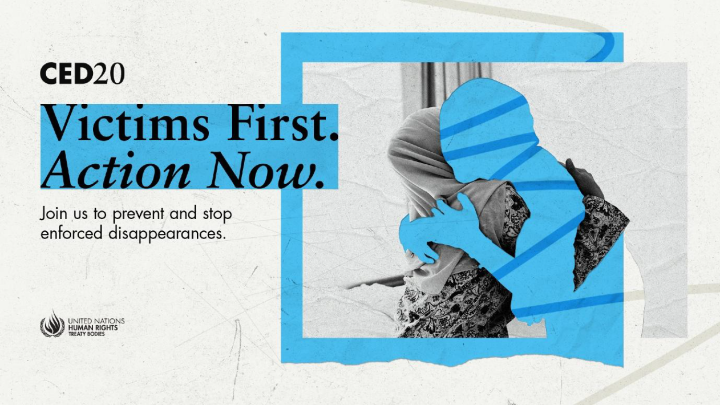
Throughout 2026, the Committee on Enforced Disappearances is leading a campaign to mobilise States, victims, civil society, national human rights institutions, UN entities and partners to raise public awareness, share concrete actions and strengthen protection against enforced disappearances. Under the slogan “Victims First. Action Now.”, the CED20 campaign puts victims at the centre of its efforts and highlights not only that enforced disappearances can be prevented but also that States and other stakeholders have clear responsibilities and tools to act.
A list of activities planned to celebrate the twentieth anniversary of the Convention can be found in the concept note for the CED20 campaign.
UN mechanisms addressing enforced disappearancesWhile implementation of the Convention is monitored by the Committee on Enforced Disappearances, a group of 10 independent experts that meets twice a year in Geneva, implementation of the 1992 Declaration for the Protection of All Persons from Enforced Disappearance is overseen by the Working Group on Enforced or Involuntary Disappearances, one of the Special Procedures of the UN Human Rights Council. The Committee and the Working Group work in a coordinated and complementary manner. The Committee on Enforced Disappearances is one of the ten UN treaty bodies. The treaty bodies are committees of independent experts that ensure the proper implementation of the human rights treaties adopted since 1965 by UN Member States. These, in turn, are part of the rules-based international order that has governed the international community since the establishment of the UN in 1945. |
[1] Article 2 of the International Convention for the Protection of All Persons from Enforced Disappearance, online, 4 March 2026.
[2] Ministry of Foreign Affairs of the French Republic. Signature of the International Convention for the Protection of All Persons from Enforced Disappearance, 2007, press kit, online, 9 February 2026.
[3] Taxil, Bérangère, "À la confluence des droits: la convention internationale pour la protection de toutes les personnes contre les disparitions forcées [At the confluence of rights: the International Convention for the Protection of All Persons from Enforced Disappearance]", Annuaire français de droit international, 2007, 53 (1), pp. 129-156, online, 9 February, 2026.
[4] Seventy-eight countries have ratified the Convention as of 27 February 2026. A regularly updated list of States parties to the Convention is available on this website.
[5] Provided that the State in question has recognised the Committee’s competence to do so (see further article 31 of the Convention).