
Human Rights Council Opens Sixty-First Regular Session, Holds Moment of Silence for Victims of Human Rights Violations Around the World
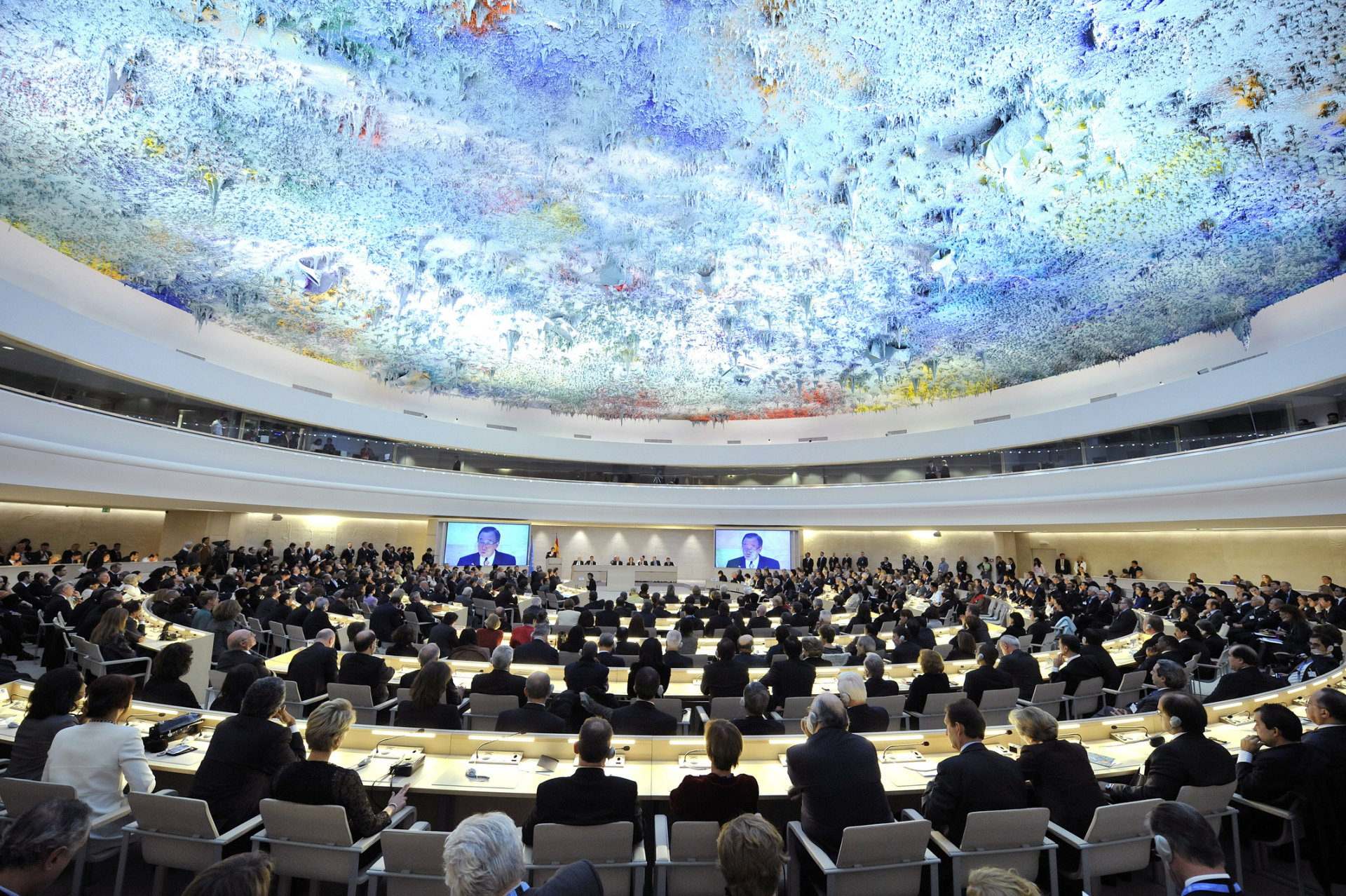
The Human Rights Council this morning opened its sixty-first regular session, hearing statements from the President of the General Assembly, the United Nations Secretary-General, the United Nations High Commissioner for Human Rights, and the Head of the Federal Department of Foreign Affairs of Switzerland. The President of the Council called for a moment of silence for victims of human rights violations around the world.
Sidharto Reza Suryodipuro, President of the United Nations Human Rights Council, said the strong presence of over 120 high-level dignitaries from all regions sent a powerful and unmistakable message: that this Council mattered, that human rights mattered, and that multilateral cooperation remained indispensable in navigating shared challenges. Mr. Suryodipuro called for this session to serve as a renewed call to listen, to cooperate, and to act, and mark the Council’s rise to the demands of the moment.
The Council then observed a moment of silence in memory of victims of human rights violations around the world.
António Guterres, United Nations Secretary-General, said human rights were under a full-scale attack around the world. When human rights fell, everything else tumbled. That was precisely why the tools of the Human Rights Council – such as the Special Procedures, Special Rapporteurs, investigative mechanisms, and the Universal Periodic Review – were so critical. It was also precisely why, as the Council marked its twentieth anniversary, it was more important than ever to translate political engagement into a path towards strengthening human rights everywhere.
Mr. Guterres recalled that, in his first address to the Council as Secretary-General, he spoke of his deep personal commitment to human rights. Growing up under the Salazar dictatorship taught him that the denial of human rights corroded every aspect of society. Working for the United Nations had shown him how respect for human rights brought out the best in humanity. Now, in his tenth year at the helm of the United Nations, the power of human rights had never been clearer.
In his final address to the Human Rights Council, Mr. Guterres appealed to the international community to not let the erosion of human rights become the accepted price of political expediency or geopolitical competition, and to not let power write a new rulebook in which the vulnerable had no rights and the powerful had no limits.
Volker Türk, United Nations High Commissioner for Human Rights, said developments around the world pointed to a deeply worrying trend: domination and supremacy were making a comeback. Behind the rhetoric of some leaders was a belief that they were above the law, and above the United Nations Charter. A tight clique of tech tycoons controlled an outsize proportion of global information flows, distorting public debate, markets, and even governance systems. Corporate and State interests ravaged the environment, robbing the riches of the earth for their own gain. But at the same time, people were not watching all this from the sidelines and were claiming their right to basic living conditions, to fair pay, to bodily autonomy, to self-determination, to be heard, to vote freely, and many other rights.
Annalena Baerbock, President of the General Assembly, said her speech today was a call to action, to everyone. As history taught us, large systems rarely collapsed in one dramatic moment: they eroded slowly, rule by rule, commitment by commitment, with those who should defend them staying silent. Until one day, what seemed permanent simply vanished. Being a member of the Human Rights Council, as Member States, as an ambassador, as a minister, as a United Nations official in these times was not a spectator sport. Silence was a choice and inaction was a choice. Yet action was a choice as well and it lay in our own hands.
Ignazio Cassis, Head of the Federal Department of Foreign Affairs of Switzerland, said that for 20 years, members of the Human Rights Council had gathered at the Palais des Nations with the same task: to protect human dignity in a world that was changing faster than its institutions. Today, crises were multiplying. In this context, human rights were not a luxury; they were a necessity and a compass. To remain credible, the Council needed to be clear and disciplined. The spirit of Geneva, forged from respect, listening and pragmatism, needed to continue to guide the Council’s work.
The webcast of the Human Rights Council meetings can be found here. All meeting summaries can be found here. Documents and reports related to the Human Rights Council’s sixty-first regular session can be found here.
The Council started its high-level segment at 10 a.m.
Opening Statements
SIDHARTO REZA SURYODIPURO, President of the United Nations Human Rights Council, said that today, the strong presence of over 120 high-level dignitaries from all regions sent a powerful and unmistakable message: that this Council mattered, that human rights mattered, and that multilateral cooperation remained indispensable in navigating shared challenges. Even amid pressures on the foundations of multilateralism, their presence reaffirmed the determination enshrined in the Charter of the United Nations — “to reaffirm faith in fundamental human rights, in the dignity and worth of the human person, and in the equal rights of men and women and of nations large and small.”
As the Human Rights Council marked the twentieth year since its establishment, it reflected not only on two decades of meaningful contributions — from fostering dialogue and cooperation among States, to advancing norms and standards, to strengthening accountability mechanisms — but also on its resilience. The Council had evolved, expanded its tools, and responded to emerging crises. It remained a central pillar of the international human rights architecture. From digital and technological risks to the impacts of climate change, conflict, inequality, and food insecurity, the Council had sought not only to deliberate, but to promote tangible improvements on the ground. This sustained engagement reflected the Council’s enduring relevance and shared commitment to universal respect for human rights, guided by universality, objectivity, non-selectivity, and the equal treatment of all rights, including the right to development.
At the same time, ongoing financial constraints within the United Nations had affected its ability to fully implement its mandate. Rather than retreat, these constraints compelled it to act with greater resolve — to innovate, remain responsive, and reinforce the multiple layers of the global human rights architecture. Regional organizations and national human rights institutions, alongside civil society, were the Council’s indispensable partners.
Mr. Suryodipuro called for this session to serve as a renewed call to listen, to cooperate, and to act — and mark the Council’s rise to the demands of the moment.
The Council then observed a moment of silence in memory of victims of human rights violations around the world.
ANTÓNIO GUTERRES, Secretary-General of the United Nations, said human rights were under a full-scale attack around the world. The rule of law was being outmuscled by the rule of force, and this assault was not coming from the shadows, or by surprise. It was happening in plain sight – and often led by those who held the greatest power. Around the world, human rights were being pushed back deliberately, strategically, and sometimes proudly. The consequences were devastating, and as written in the lives of people who suffer twice: first from violence, oppression, or exclusion – and then again from the world’s indifference. When human rights fell, everything else tumbled. That was precisely why the tools of the Human Rights Council – such as the Special Procedures, Special Rapporteurs, investigative mechanisms, and the Universal Periodic Review – were so critical. It was also precisely why, as the Council marked its twentieth anniversary, it was more important than ever to translate political engagement into a path towards strengthening human rights everywhere.
Mr. Guterres said that tomorrow, he should address the Security Council on the fourth anniversary of Russia’s full-scale invasion of Ukraine, where more than 15,000 civilians had been killed. It was more than past time to end the bloodshed. He recalled earlier this month speaking to the Committee on the Exercise of the Inalienable Rights of the Palestinian People about blatant violations of human rights, human dignity, and international law in the Occupied Palestinian Territory. The current trajectory was stark, clear and purposeful: the two-State solution was being stripped away in broad daylight. The international community could not allow it to happen. He also recalled, a few days ago, attending the African Union Summit, where Sudan, the Democratic Republic of the Congo, the Sahel and other crises were front and centre.
This was a world where mass suffering was excused away, where humans were used as bargaining chips, where international law was treated as a mere inconvenience. Conflicts were multiplying and impunity had become a contagion. This was not due to a lack of knowledge, tools or institutions. It was the result of political choices. This crisis of human rights mirrored and magnified every other global fracture. Humanitarian needs were exploding while funding collapsed. Inequalities were widening at staggering speed. Countries were drowning in debt and despair. Climate chaos was accelerating. Technology – especially artificial intelligence – was increasingly being used in ways that suppressed rights, deepened inequality, and exposed marginalised people to new forms of discrimination both online and offline.
Across every front, those who were already vulnerable were being pushed further to the margins, and human rights defenders were among the first to be silenced when they tried to warn us. In this coordinated offensive, human rights were the first casualty. This was apparent in a tightening grip on civic space, with journalists and activists jailed; non-governmental organizations shut down; women’s rights rolled back; children’s rights ignored; persons with disabilities excluded; democracies eroded; migrants harassed, arrested and expelled; refugees scapegoated; lesbian, gay, bisexual, transgender and intersex communities vilified; minorities and indigenous peoples targeted; religious communities attacked; online spaces poisoned by disinformation and hate; and the right of peaceful assembly crushed. Mr. Guterres repeated his condemnation of the violent repression of protests in Iran.
Human rights were not a slogan for good times; they were a duty at all times. The world needed to stand up for them – even when it was difficult, inconvenient, or costly. That required action on three urgent fronts. First, the international community needed to defend its shared foundations, without compromise. The United Nations Charter, the Universal Declaration of Human Rights, and the instruments of international human rights law were not a menu. Leaders could not pick the parts they liked and ignore the rest. Human rights themselves were also not divisible. Economic rights, social rights, cultural rights, civil rights, and political rights were inherent, universal, inalienable and interdependent.
Second, institutions needed to be strengthened. The dysfunction of today’s global governance system was not somehow separate from the global deterioration of human rights. The push to update and strengthen the Security Council and the international financial architecture was not institutional housekeeping; it was essential to ensuring the protection of human rights and fundamental freedoms. When the Security Council was blocked, when vetoes became political cover, and when geopolitical rivalries overrode the protection of civilians, impunity grew, suffering multiplied, and human rights were trampled. The international community needed a Security Council that reflected today’s world, not the world of 1945.
The same was true for the international financial architecture. When small and vulnerable countries were trapped in debt and deprived of adequate investment, their people were deprived of their human rights – including education, healthcare, safety and dignity. The UN80 Initiative reinforced the link between human rights, peace, sustainable development, and protection in humanitarian settings, to ensure these areas worked in a more coherent and mutually reinforcing way. It called for the establishment of a system-wide Human Rights Group to deepen human rights integration across all United Nations policies and activities. Mr. Guterres thanked the High Commissioner for chairing this effort, which built on the Call to Action for Human Rights.
Third, the power of human rights needed to be unlocked. Human rights lifted the world to a better place. When rights were upheld, people lived more freely, economies grew more fairly, communities trusted more deeply, and peace and stability took hold as dignity took root. Human rights were not an obstacle to progress – they were essential to progress. Time and time again, where rights advanced, conflict lost ground. Where justice strengthened, violent extremism weakened. Where equality expanded, possibility exploded. Where freedom prevailed, societies flourished. The international community needed to change course by renewing its commitment to respect for the rule of law at every level; by supporting the pivotal work of the International Court of Justice and the International Criminal Court; by delivering on the Sustainable Development Goals; by accelerating climate action; and by upholding all that made humanity “human”.
Mr. Guterres recalled that, in his first address to the Council as Secretary-General, he spoke of his deep personal commitment to human rights. Growing up under the Salazar dictatorship taught him that the denial of human rights corroded every aspect of society. Working for the United Nations had shown him how respect for human rights brought out the best in humanity. Now, in his tenth year at the helm of the United Nations, the power of human rights had never been clearer.
Human rights were not West or East, North or South. They were not a luxury, and they were not negotiable. They were the foundation of a more peaceful and secure world. States were bound by their obligations under the Charter and international law. There was still much work ahead.
In his final address to the Human Rights Council, Mr. Guterres appealed to the international community to not let the erosion of human rights become the accepted price of political expediency or geopolitical competition, and to not let power write a new rulebook in which the vulnerable had no rights and the powerful had no limits. He called for the Human Rights Council to be the voice and shield for all those in need; a place that helped end the broad and brutal assault on human rights. A world that protected human rights protected itself, he concluded.
VOLKER TÜRK, United Nations High Commissioner for Human Rights, said a fierce competition for power, control and resources was playing out on the world stage at a rate and intensity unseen for the past 80 years. People’s pursuit of dignity, equality and justice meant everyone wanted to be free, to be heard, and to have basic needs met. This was a strong counterbalance to the top-down, autocratic trends seen today. The use of force to resolve disputes between and within countries was becoming normalised. The laws of war were being brutally violated, with mass civilian suffering unfolding before our eyes.
In Sudan, there needed to be accountability for all violations by all parties and all those with influence needed to act urgently to put an end to the senseless war. The situation in Gaza remained catastrophic. Palestinians were still dying from Israeli fire, cold, hunger, and treatable diseases and there were concerns over ethnic cleansing in both Gaza and the West Bank. Any sustainable solution must be based on two States living side by side in equal dignity and rights, in line with United Nations resolutions and international law. Tomorrow marked four years since Russia’s full-scale invasion of Ukraine. Civilian casualties had soared, and Russia’s systematic attacks on Ukraine’s energy and water infrastructure could amount to international crimes. The fighting needed to end, there must be human rights and justice in any ceasefire or peace agreement.
In Myanmar, five years after the military coup, the conflict was claiming even more civilian lives, and the humanitarian situation continued to deteriorate, exacerbated by the recent elections staged by the military. Across most violent conflicts today, journalists, health and aid workers were targeted in blatant violation of international law; this must not be the new normal. Violence and tensions were resurging in some countries, including South Sudan and Ethiopia. Authorities in Iran had violently repressed mass protests with lethal force, killing thousands.
Developments around the world pointed to a deeply worrying trend: domination and supremacy were making a comeback. Behind the rhetoric of some leaders was a belief that they were above the law, and above the United Nations Charter.
A tight clique of tech tycoons controlled an outsize proportion of global information flows, distorting public debate, markets, and even governance systems. Corporate and State interests ravaged the environment, robbing the riches of the earth for their own gain. But at the same time, people were not watching all this from the sidelines and were claiming their right to basic living conditions, to fair pay, to bodily autonomy, to self-determination, to be heard, to vote freely, and many other rights. From Nepal to Madagascar, from Serbia to Peru and beyond, people were demanding equality and denouncing corruption. Human rights were anathema to supremacy: they were a direct challenge to those who sought and clung to power. They were universal, timeless and indestructible.
Mr. Türk said human rights did not magically appear with the Universal Declaration on 10 December 1948; people had been seeking freedom and equality long before these principles were codified in national or international agreements. This included in the late 1700s, where enslaved people in modern-day Haiti rose up against colonial rule, in the name of racial equality. The American and French revolutions challenged unaccountable authority and the Abolitionist movement was a rejection of the Transatlantic slave trade. In the early 1900s, women joined together to demand the right to vote. After the bloodshed of two World Wars and the Holocaust, the United Nations Charter reasserted faith in fundamental human rights. The twentieth century then ushered in a period of decolonisation, with people mobilising to end racial segregation, for labour rights, and to protect the rights of lesbian, gay, bisexual and transgender persons. Mothers marched together to seek justice for their disappeared children, from Argentina to Sri Lanka, and young people raised their voices for climate justice.
Human rights were the thread that ran through all these movements. While some States were weakening the multilateral system, there needed to be bolder and more joined-up responses. This meant calling out violations of international law, regardless of the perpetrators; a stronger commitment to accountability, including strengthening the International Criminal Court and encouraging national prosecutions under the principle of universal jurisdiction; and forging coalitions to champion what united us, and upheld equality, dignity, and justice for all. In the coming weeks, a Global Alliance for Human Rights would be set in motion to capture the energy and commitment that was palpable everywhere. This would be a cross-regional, multi-stakeholder coalition of States, businesses, cities, philanthropists, scientists, artists, philosophers, young people and civil society. Our future depended on our joint commitment to defend every person’s rights, every time, everywhere.
ANNALENA BAERBOCK, President of the General Assembly, said everyone in the room agreed in principle how important human rights were and how they were under attack. She began her speech reflecting on the human rights violation of the gender apartheid system against Afghan women and girls. This should remind all that appeasement in the light of severe human rights violations never prevailed and that we should not learn the hard way that women’s rights were indeed the benchmark for the state of a society, the state of the world. If women, who made up half of the population, were not safe, the world was not safe. All were seeing not only a dramatic backlash in women and human rights but also that other rules and standards which were believed to be set in stone, were now openly questioned, dismissed, or violated.
Ms. Baerbock said her speech today was a call to action, to everyone. As history taught us, large systems rarely collapsed in one dramatic moment: they eroded slowly, rule by rule, commitment by commitment, with those who should defend them staying silent. Until one day, what seemed permanent simply vanished. Being a member of the Human Rights Council, as Member States, as an ambassador, as a minister, as a United Nations official in these times was not a spectator sport. Silence was a choice and inaction was a choice. Yet action was a choice as well and it lay in our own hands.
The human rights system, the Universal Declaration, the principles as enshrined in the Charter needed this action now. Action from governments and diplomats, officials and parliamentarians: support, leadership, and cross-regional cooperation. This was needed to protect, defend and champion all three principles of the Charter, including peace and security, development as well as human rights. As the Pact for the Future stated, the three pillars were equally important, interlinked and mutually reinforcing. Ministers needed to uphold human rights in their national debates when in highly populistic times some challenged the Geneva Convention of Refugees again, or started allowing child marriage or spread antisemitic, racist or Islamophobic propaganda.
It needed a clear commitment from every Member State that United Nations premises were inviolable, and that their schools were essential for guaranteeing Palestinian children their right to education. It needed commitment that the abduction of Ukrainian children was a war crime, and that people everywhere, including in Iran, had the right to demonstrate peacefully and freely. It needed all of us to neither give in nor give up because of the humanitarian catastrophe, starvation mass killings and mass rape in Sudan, and the devastating situation of the Rohingya.
It needed our common understanding that human rights work was static and must evolve as new threats to human dignity emerged. This included the rapidly evolving fields of technology and artificial intelligence. Used responsibly, it could expand knowledge, improve healthcare, strengthen disaster response, and support climate-resilient agriculture. But without safeguards, these same technologies risked entrenching bias and amplifying harm, even teaching children how to commit suicide. Responsible global governance of technology was therefore essential, highlighted at the Artificial Intelligence Summit as well as the United Nation’s new Independent International Scientific Panel on Artificial Intelligence, approved by the General Assembly just 11 days ago.
It needed everyone here in Geneva as well those in New York together to engage jointly in the UN 80 reform process, from avoiding overlap between the Human Rights Council and the Third Committee, to duplication across agencies. Finally, for an institution built on human rights, representing all of the people, one question loomed large: how was it that within 80 years a woman had never served as Secretary-General? The Olympics showed us again what could be achieved when we came together, despite our differences, to compete fiercely, yet fairly, on the same playing field, governed by the same rules, in mutual respect. Ms. Baerbock said it was up to everyone to defend these principals, our common, global human rights here. In Geneva, in New York, and all around the world.
IGNAZIO CASSIS, Federal Councillor and Head of the Federal Department of Foreign Affairs of Switzerland, said that for 20 years, members of the Human Rights Council had gathered at the Palais des Nations with the same task: to protect human dignity in a world that was changing faster than its institutions. Today, crises were multiplying. Trust was eroding between States and societies, and sometimes even within institutions. Resources were becoming scarce, while expectations and needs seemed limitless. Technological advances opened new prospects but also created new risks for freedoms. In this context, human rights were not a luxury; they were a necessity and a compass.
To remain credible, the Council needed to be clear and disciplined. It needed to focus its efforts where rights were most at risk and aim for a genuine impact. This was the approach that Switzerland had adopted in its new guidelines: recalibrating to focus on the essentials — the protection of the individual and their fundamental freedoms — while reaffirming the universality and indivisibility of rights.
Twenty years after its creation, the Council needed to more than ever be a place of genuine dialogue — beyond mere declarations — capable of acting in the face of crises. Progress existed, but it remained fragile and unevenly shared. In a fragmented world, it was essential to preserve places where dialogue remained possible — even, and especially, when positions diverged profoundly. Geneva was one of those places. The spirit of Geneva — forged from respect, listening and pragmatism — needed to continue to guide the Council’s work.
___________
Produced by the United Nations Information Service in Geneva for use of the media;
not an official record. English and French versions of our releases are different as they are the product of two separate coverage teams that work independently.
HRC26.004E